

AFTERWORD
‘Like Family’
By Umberto P. Fedeli
Illustration by Ken Kula
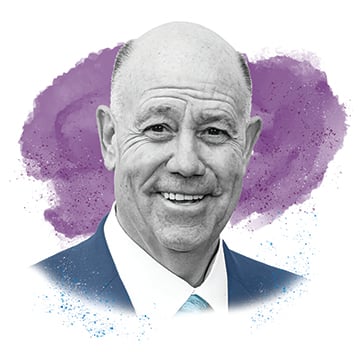
Umberto P. Fedeli
I felt unwell, with chills, fatigue and persistent pain in my shoulder and back. I was tested for flu and COVID; the results came back negative. So I carried on with my daily responsibilities.
I tried to push through all of it, the way I usually do. But after more than two weeks with no signs of improvement, I reached out to Jim Hekman, MD, through Cleveland Clinic’s concierge medicine program. He urged me to come in immediately.
Blood cultures revealed a rare and extremely dangerous infection in my collarbone that had spread to my bloodstream. I was admitted to Cleveland Clinic Hillcrest Hospital, where I received
IV antibiotics.
Discharged five days later, I thought I was finally on the road to recovery. Or so I hoped.
Dr. Hekman insisted on a follow-up visit. Pressing a stethoscope to my chest, he didn’t like what he heard. An echocardiogram confirmed there was good reason to be concerned: The infection had destroyed my mitral valve, which controls blood flow between the chambers on the left side of the heart.
“I don’t know how you’re still walking,” Dr. Hekman told me.
Within hours, I was admitted to Cleveland Clinic’s main campus for emergency cardiac surgery. I was thoroughly evaluated by a multidisciplinary team of specialists, including experts in cardiology, infectious disease, thoracic surgery, radiology and interventional imaging. Together, they determined the safest and most effective course of action.
I was confused. I had been healthy. No history of heart trouble. How was this happening?
Cardiac surgeon Marc Gillinov, MD, explained that the team would attempt to repair the damaged valve using a robotic approach, which is less invasive and carries a lower risk of infection. If that wasn’t possible, open-heart surgery would be needed. And if the valve was beyond repair, it would have to be replaced with a mechanical valve or a pig valve.
“So I might not have a kosher Italian heart anymore?” I joked.
I did my best to stay positive, but the night before the surgery was a long one. I’m a proud son of immigrant parents who grew up in a working-class neighborhood where we toughed out everything. Lying in that hospital bed and facing the unknown, I felt concerned and humbled.
Early on a Friday morning in mid-November, I was taken into the operating room. Many hours later, I woke up in the ICU to learn that the procedure had been a success. Dr. Gillinov was able to complete a fully robotic repair, fixing the ruptured valve, repairing a second leak and placing a ring to stabilize it.
As I recovered, what stayed with me most was not just the outcome of the surgery, but the team of teams at Hillcrest Hospital and on main campus that looked after me. From the specialists who examined every angle of my case, to the nurses who reassured me during difficult moments, to the imaging technicians who guided me through CT scans, ultrasounds and X-rays, I experienced care that felt deeply personal. I remember the caregiver who shaved and prepped me before surgery, the anesthesiologist who promised to keep me comfortable and the transporter who wheeled me to the OR with calm reassurance.
Seeing Cleveland Clinic from a patient’s perspective only deepened my appreciation for its culture of collaboration and wonderful, compassionate caregivers.
None of us knows when we or someone we love will need this level of care. But when that moment comes, you want to know an entire experienced team is there — working together, focused on you. At every step, I felt like I was being treated like family.
Umberto P. Fedeli is CEO of The Fedeli Group, one of the largest privately held risk management and insurance firms in Ohio. A longtime Cleveland Clinic benefactor, he serves on Cleveland Clinic’s Board of Directors and is a driving force behind the annual Derby Soirée benefiting Cleveland Clinic Children’s. In gratitude for the care that saved his life, he made a generous gift to support Cleveland Clinic caregivers.