

Small Patients, Big Mission
FEATURE
By John Soeder
“The smaller the patient, the closer I am to my happy place.”
Dr. Miguel Guelfand
Across the United States, fewer than 1 in 10 newborns who need surgery receive it through minimally invasive techniques. At Cleveland Clinic Children’s, that number is 100 percent.
The distinction is no accident. It’s the result of a deliberate, ambitious vision that Miguel Guelfand, MD, has been pursuing since joining Cleveland Clinic in 2023 as Section Head of Pediatric General and Thoracic Surgery. “The smaller the patient, the closer I am to my happy place,” Dr. Guelfand says. “In these little patients, you cannot miss any tiny thing. That’s the difference between a successful surgery and a complication. And I love that challenge.”
Dr. Guelfand came to Cleveland from his native Chile, where he built a fulfilling career with his wife, Paula Escobar, MD — also a surgeon, now also at Cleveland Clinic. He trained on four continents, completing fellowships in Australia and England. When Cleveland Clinic extended an invitation, what drew him was a specific challenge: to be part of a team that takes pediatric surgery to the same standard of excellence that has made Cleveland Clinic a global leader in adult medicine.
“To be part of changing that — that was a very nice challenge to accept,” Dr. Guelfand says.
The MIS difference
The results to date have been striking. The pediatric surgery team has nearly doubled, with recruits drawn from institutions in Spain, Chile and beyond. Case volume has increased by more than 30 percent. Where the program once sent some complex cases elsewhere, today’s team can manage any condition a child presents — at any age, including the most fragile newborns.
The program’s signature strength is minimally invasive surgery (MIS), which entails performing complex procedures through incisions as small as 3 millimeters. For newborns, that can mean correcting life-threatening malformations of the esophagus, lungs, intestines and diaphragm without the long recovery and complications that open surgery brings. Cleveland Clinic Children’s is one of only a handful of centers in the country that performs all neonatal surgery this way.
Why hasn’t MIS become the national standard? “If your pediatric surgery fellowship is two years and then you are sent somewhere alone, with nobody to teach you, it’s very difficult to adopt this technique,” Dr. Guelfand says.
His solution is to change that equation. In 2024, he launched the first International Neonatal Minimally Invasive Surgery Symposium, now an annual event. “We want to teach surgeons,” he says, “so they can
go back and do these better and safer surgeries in their own hospitals.”
‘A team effort’
Beyond neonatal MIS, the program has built rapid expertise in pediatric surgical oncology, fetal surgery, colorectal surgery and transplant. Cleveland Clinic Children’s also has the largest program in the country for chest wall deformity.
Through it all, Dr. Guelfand is happy to share the spotlight. “This is a team effort,” he says. “One player doesn’t make any difference. We need a team.”
Philanthropic support is essential to this mission. Donor investment has already made a tangible difference by funding the program’s first research fellow. Looking ahead, Dr. Guelfand sees two critical needs: resources to launch and expand programs without waiting for budget cycles, and support for the educational mission spreading Cleveland Clinic’s expertise nationally and internationally. An endowed chair and gifts at all levels would help ensure that the momentum in recent years becomes the standard of the next decade.
“We really want to be the best place for every child to come for the best treatment with the best outcomes,” Dr. Guelfand says. “That’s what really drives our team.”
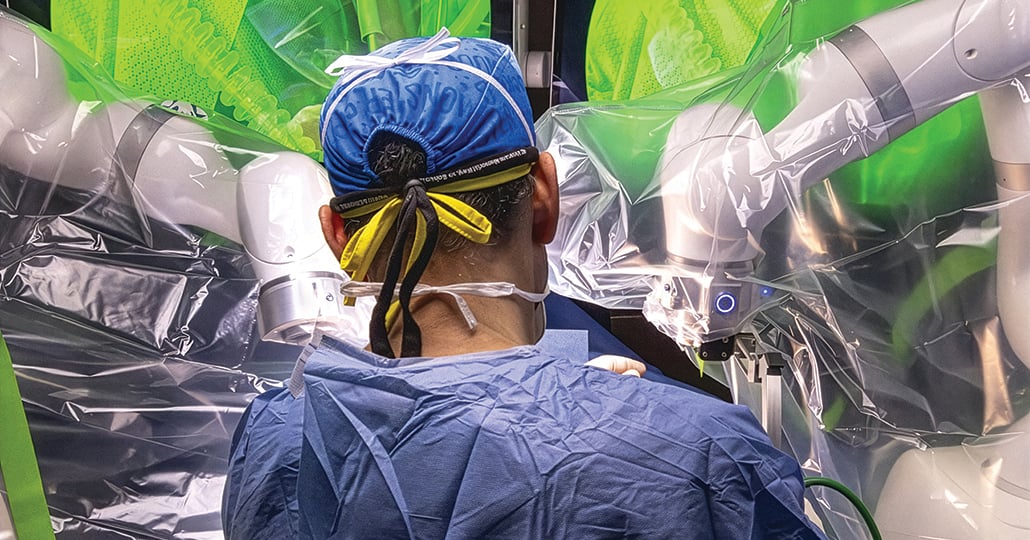
Minimalist Milestone
In November 2025, Cleveland Clinic Children’s was the first hospital in the United States to use FDA-cleared magnetic-assisted surgical technology for a MINIMALLY INVASIVE PEDIATRIC GALLBLADDER REMOVAL. “These approaches are especially important in pediatric surgery,” says Miguel Guelfand, MD, who performed the procedure. “Smaller incisions and less tissue disruption can mean less pain, faster recovery and a better overall experience.” | Photo by Annie O'Neill